In today's blog post, we will explore the fascinating subject of horse coat colours. Every horse lover has surely wondered at some point what the different coat colours of these majestic animals are called. Horses display an extraordinary variety of coat colours, encompassing a wide range of colours, patterns and shades. A reddish, white or black coat, with a dark or light mane - every variation has its own specialist name. These range from familiar colours such as chestnut and black to more unusual and rarely seen ones such as pearl and silver black. Exploring the diversity of horse coat colours enriches our knowledge of these beautiful animals.

In today's blog post, we will explore the fascinating subject of horse coat colours. Every horse lover has surely wondered at some point what the different coat colours of these majestic animals are called. Horses display an extraordinary variety of coat colours, encompassing a wide range of colours, patterns and shades. A reddish, white or black coat, with a dark or light mane - every variation has its own specialist name. These range from familiar colours such as chestnut and black to more unusual and rarely seen ones such as pearl and silver black. Exploring the diversity of horse coat colours enriches our knowledge of these beautiful animals.
Here are a few examples of basic horse coat colours:
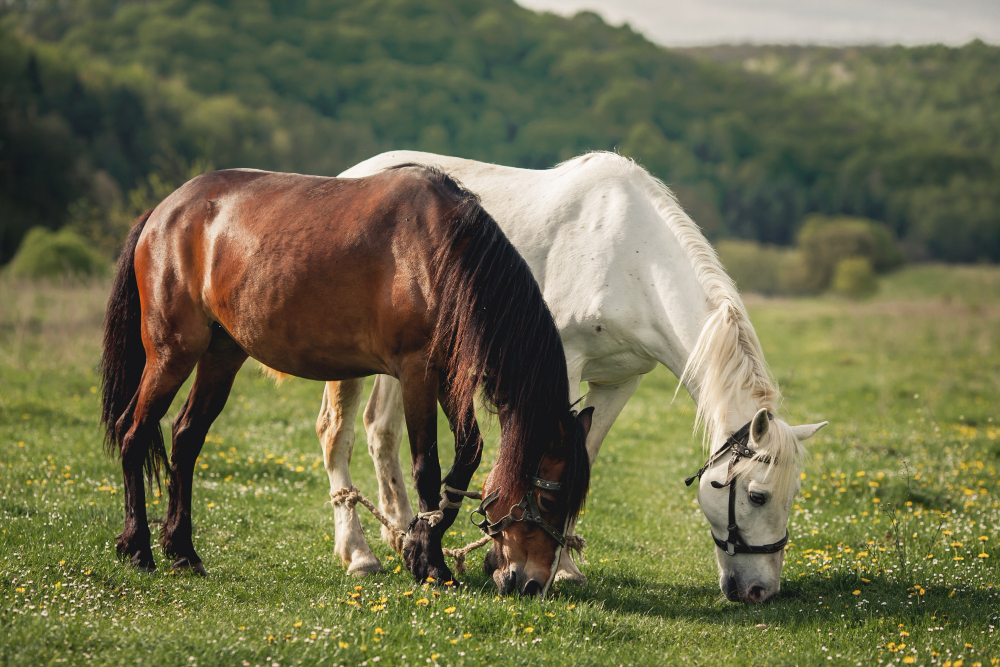
Chestnut: chestnut horses have a brown or reddish coat. The mane and tail are usually the same colour or distinctly lighter. There are various shades of chestnut, such as light chestnut (English: light chestnut), dark chestnut (English: dark chestnut) and dark chestnut with a flaxen mane and tail (English: flaxen dark sorrel).
Bay: a bay coat is characterised by brown body hair and a black mane and tail.
Dark bay (English: dark bay): it is easy to confuse this colour with other, similar coat colours. Dark bay horses have a dark brown coat with an admixture of black hairs and darker legs, usually black.
Seal brown: seal brown horses have an almost black coat with visible lighter areas, particularly around the nostrils or flanks. In winter, they can easily be mistaken for black horses.
Black: black horses have a black coat, and their manes and tails are also usually dark. A black coat is characteristic of Friesian horses.
Grey: grey horses have coats in various shades of white. The mane and tail remain the same colour.
Palomino: characterised by a golden coat, often with a light mane and tail. Palomino horses are often admired for their intense colour.
Dun: dun horses have a yellowish-brown coat. A dorsal stripe usually runs down the middle of the back. Dun horses have a black mane and tail. This colour is characteristic of Fjord horses, for example.
Rarer coat colours include:
Perlino: this is a rare coat colour in which horses have a cream-coloured coat and white or beige manes and tails. Because there are two copies of the gene responsible for this colour, perlino can be described as a double-diluted bay. When one copy of the same gene is present, the result is buckskin.
Buckskin: horses of this colour have a golden coat and a black mane, tail and legs. This colour resembles dun, but the distinguishing feature is usually the absence of a dorsal stripe in buckskin horses.
Silver black: a diluted black coat colour. The brown coat takes on a chocolate shade, while the mane and tail are lighter, almost white.
These are just a few examples; in reality, there are many combinations and variations of horse coat colours, making every horse unique in appearance.
Overo/Tobiano/Splash White: these coat patterns are associated with pinto horses and describe the pattern of white hair. White patches occur in various arrangements over the base colour. A white patch can be extensive and may even cover most of the back. The colour of the mane and tail depends on the coat colour, although lighter strands may occur within them.
Leopard complex spotting: there are many variations of this coat pattern, and the pattern can also change as the horse ages. Their white coats are sprinkled with dark spots, and their manes and tails are black with light strands, although white hairs may also predominate, depending on the type of leopard complex pattern.
Dapple grey: this coat colour is characterised by a grey coat with lighter areas formed by white hairs, somewhat resembling snowflakes or apples in shape. The legs are usually darker, but they may have white markings.
Another example of a white coat pattern is roan, in which white hairs are mixed with the base colour. There are usually far fewer white hairs on the legs and head. The mane and tail vary in colour depending on the base coat colour.
A lack of melanin in a horse's iris can lead to an interesting phenomenon - blue eyes. This phenomenon is particularly characteristic of horses with diluted coat colours, specifically cremello, whose coats have a subtle creamy glow. Pink skin and blue eyes are also characteristic of these horses. This is not only a unique physical feature but also a reminder of how diverse these animals can be.
However, blue eyes are not the only ones that attract interest. Horses with a visible white sclera have a gaze with a somewhat human charm. Leopard complex spotting often occurs alongside this feature. Even when the eyes are the usual hazel colour, the presence of a white sclera makes their gaze distinctive and almost hypnotic.
Every horse has its own unique story, and the eyes are one of the most personal expressions of its character. This is why, when we look deep into a horse's eyes, we can see not only beauty but also the emotions and mystery that make these animals fascinating.
Explore categories that may interest you after reading this post:
The equine world offers an extraordinary wealth of colours, from basic coat colours such as chestnut, bay and black to rarer varieties such as perlino and silver black. Each coat colour has its own unique charm and attracts admirers of its beautiful shade.
Some people appreciate the classic, natural base coat colours. These colours radiate strength and elegance, evoking the traditions and history of horses. Others admire unusual horse coat colours such as smoky cream, with their almost magical hues.
To conclude, the question of which horse coat colour is the most beautiful remains impossible to settle. Yet it is undeniable that a horse of any colour, with a dark or light mane, is beautiful in its own way. What makes horses special is not only their coat colour but also their character, bearing and the unique bond they form with people. This is why the question of the most beautiful horse coat colour has no definitive answer - it is the subtle combination of coat colour and personality that makes every horse one of a kind.
check_circle
check_circle


